
How Much Water Does a Sprinkler Use in 30 Minutes?
How much water a sprinkler uses in 30 minutes depends on its flow rate, so no single figure fits every yard. A small spray head, a rotor and a hose-end sprinkler each discharge at a different rate, and the pressure in your pipes changes that rate further. This guide shows how to turn a per-minute rating into a half-hour total for one head, a full zone and a whole week. It also explains what published flow figures mean, how pressure and nozzles change the result, and which problems to watch for while the system runs. It ends with how to turn the total into a sensible plan for your grass.
Quick answer: It depends on the sprinkler's flow rate. Multiply its gallons or litres per minute by 30, then add every head on the zone. Nozzle, head type and water pressure all change the rate, so use the rating for your own heads.
Why there is no single figure for a sprinkler
The volume a sprinkler puts out in half an hour comes down to two things: how fast it flows and how long it runs. Flow is quoted per minute, in US gallons or litres, and everything else follows from that rate. Run time is the part you set on the timer. Flow rate depends on the nozzle, the head design and the pressure in your pipes.
That is why two neighbours can run their systems for the same half hour and use very different volumes. A small fixed spray head, a rotor throwing a stream across the yard, and an oscillating unit on the end of a hose each have their own rating. The same head also behaves differently on a strong supply than on a weak one.
The number that matters for your bill and for your grass is the total for the whole zone, not for one head. When a valve opens, every head on that circuit flows at once, so the zone uses the sum of all of them for every minute it stays open. If you only know the figure for one head, you have only part of the answer.
It also helps to separate two questions people often blend together. The first is how much leaves the pipe. The second is how much lands evenly on the turf and soaks into the soil. A system can deliver a large volume and still leave dry strips, puddles and runoff. Treat the half-hour total as a starting point for planning, not as proof that the lawn got what it needed.
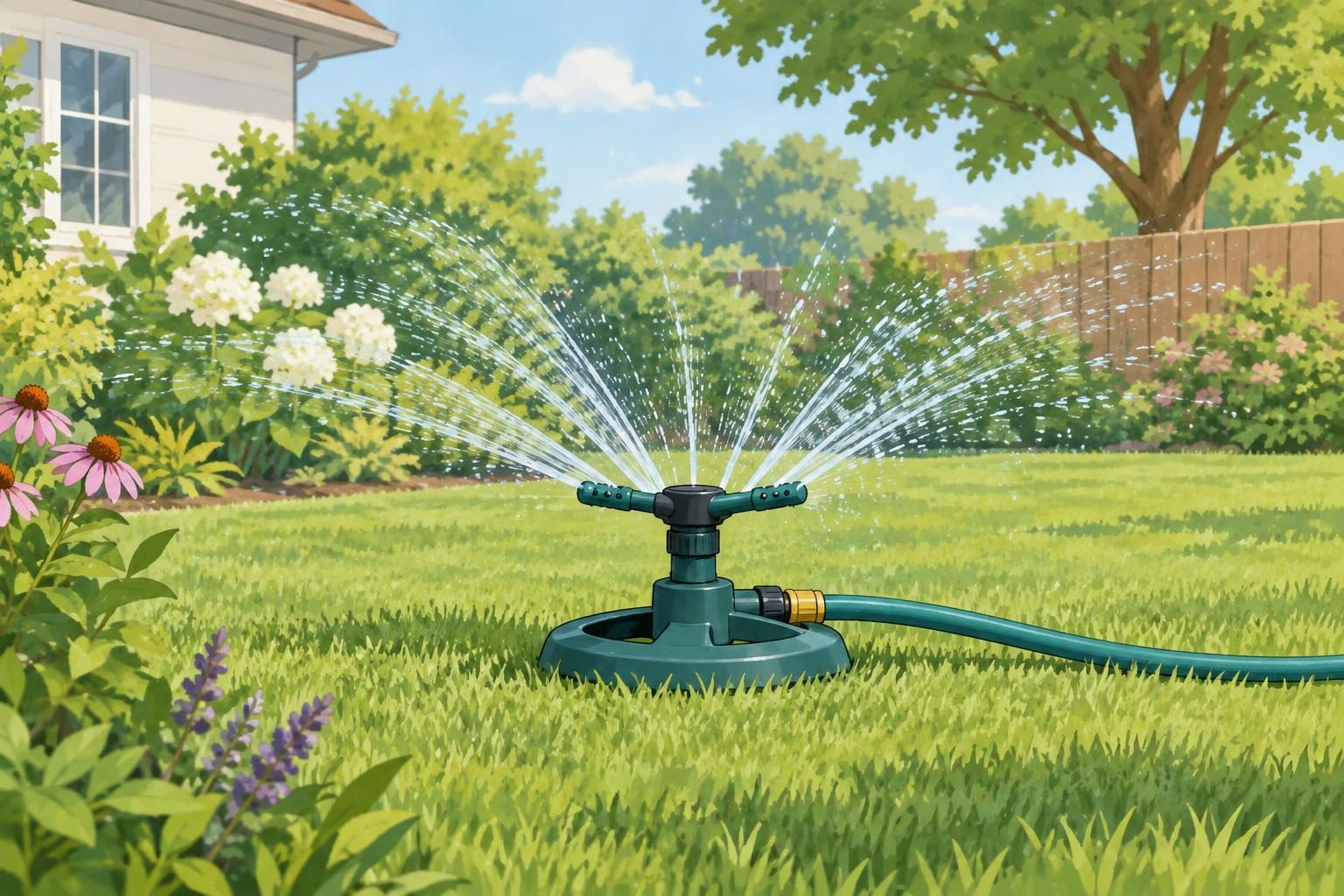
How to work out 30 minutes of sprinkler water use
The arithmetic is short once you have the right inputs. Work through it zone by zone rather than trying to estimate the whole yard at once:
- Find the flow rating for each head or nozzle on the zone, in gallons or litres per minute.
- Add those ratings together to get the zone's flow for each minute it runs.
- Multiply that zone total by the run time, which here is 30 minutes.
- Repeat for every zone, then add the zone totals if you want a figure for the whole property.
- Multiply by the number of watering days to see what a full week adds up to.
This is a small version of what fire protection engineers do with far more rigour. In their work, calculations are performed to prove that the system can deliver the required amount of water over the required design area [1]. The method carries over directly. Add up what each outlet delivers, consider whether the supply can keep up, and compare the result with the area you need to cover.
The zone-by-zone approach matters because controllers rarely run every zone for the same time. A shady bed near the house might run briefly while a sunny front lawn runs much longer, so a single property-wide guess hides large differences between areas. Working per zone also tells you where most of your volume goes, which is useful when you later decide where to cut back.
If your heads carry no visible rating and the original paperwork is gone, ask the installer or a local irrigation contractor what nozzles are fitted. They can also tell you what pressure the system runs at. Guessing a rating and multiplying it by 30 only multiplies the guess.
Tip: Once you have a total for each zone, write it inside the controller cover next to the zone name. The next time you change run times for hot weather or a dry spell, you can see at a glance what each extra minute costs in volume.
What fire sprinkler flow figures show
The most detailed published figures on sprinkler flow come from fire protection rather than lawn care. They are useful for getting a feel for scale and units, as long as you remember the two systems do different jobs. In the United States, fire sprinkler systems are designed and installed under NFPA 13 [1]. Lawn irrigation and fire systems share the same basic layout of heads fed by pressurised pipe, but a fire system has to soak a burning room fast, while a lawn system aims to spread moisture gently over turf.
On the fire side, supply figures such as 380 litres per minute (100 US gal/min) [1] appear in the design. Pressure figures such as 50 psi (340 kPa) [1] appear alongside them. Much smaller rates, such as 0.1 US gallons per minute (0.38 L/min) [1], also show up. Each of these rates describes 60 seconds [1] of flow, which is the same per-minute convention lawn irrigation uses. Read any of them as one minute of output, then scale it to your own run time.
| Figure from fire sprinkler design | What it describes | What it tells a lawn owner |
|---|---|---|
| 380 litres per minute (100 US gal/min) [1] | A supply flow rate | Flow is stated per minute, often in both litres and US gallons |
| 50 psi (340 kPa) [1] | A working pressure | Pressure is part of the design, not an afterthought |
| 0.1 US gallons per minute (0.38 L/min) [1] | A small flow rate | Small per-minute rates still add up over a long run |
Do not use these numbers as ratings for lawn heads. They come from a different kind of system, built to a different standard and for a different purpose. Their value here is that they show how flow and pressure are written down. They also show why a sound estimate always starts from the specific rating of the equipment in front of you.
How pressure, nozzles and spray patterns change the total
Pressure is the variable people overlook most often. A head rated at one pressure will discharge a different amount when your supply runs higher or lower. Higher pressure tends to push more through the nozzle and can break the stream into fine mist that drifts on the wind. Low pressure reduces flow and throw, so the outer edge of each spray pattern gets less than the area near the head.
Nozzle size and arc matter too. A head covering a quarter circle and one covering a full circle can share a zone, and the nozzles fitted to them decide whether they put down a similar depth across the ground each one serves. When one part of a zone ends up wetter than another, the usual reaction is to add minutes for the dry part. That raises the half-hour total without fixing the cause.
Head type sets the general pace. Fixed spray heads put down moisture quickly over a small area. Rotors move a stream slowly across a larger area. Hose-end units depend on how far the tap is opened, the hose length and the household pressure at that moment. That makes their output for any half hour hard to pin down without a professional measuring it.
Spray heads and rotors also deliver at different paces, so a run time that suits one type can overwater or underwater the ground served by the other if both sit on the same zone. In that case the 30-minute total for the zone can be accurate while the coverage is still uneven. Matching nozzles and grouping heads correctly is a job for an irrigation contractor, who can confirm what is fitted and advise on regrouping heads so each zone runs one type.
Checks to make while each zone runs
A flow calculation tells you what the system should use. Watching it run tells you whether it actually behaves that way. The simplest habit is to just run each zone while you’re outside and actually watch [2]. Set the controller to run one zone at a time, stand where you can see every head on it, and give it long enough to settle.
As it runs, look at the base of each head and the ground around it. You need to look for bubbling at the base, which could mean a cracked head, dry patches next to sprinklers, which means poor coverage [2]. Also look for sprinkler heads that are spraying sideways or barely popping up at all [2].
Each of these problems throws off your 30-minute estimate in a different way:
- A cracked head can leak more than its rating, so the zone uses more than your sum predicts.
- A head spraying sideways sends output onto paths, fences or the house instead of the turf.
- A head that barely pops up leaves its spray blocked by grass, so the patch around it stays dry.
- Dry patches next to heads mean the volume is leaving the pipe but not reaching the soil where it is needed.
Warning: Do not lengthen the run time to cover a dry spot caused by a damaged or blocked head. Every extra minute applies to the whole zone, so you raise the water use of every head while the fault stays in place. A cracked head left running can also soften and wash out the soil around it. Repair or replace the part, or call an irrigation technician, before you adjust the schedule.
If every head looks sound but the lawn still struggles, the cause may lie in the ground rather than the system. Compacted soil takes in moisture poorly, and our guide on how to aerate a lawn covers that job in detail. An irrigation contractor can help you tell whether the equipment or the soil is the problem.
Common mistakes when estimating how much a sprinkler uses
Most wrong estimates come from a short list of habits. Checking your own figures against them catches the bulk of errors:
- Counting one head instead of the zone. The valve feeds every head on the circuit at once, so a single rating understates the total.
- Assuming a rating holds at any pressure. If your supply runs higher or lower than the design pressure, real output shifts with it.
- Borrowing fire sprinkler numbers for a lawn. They describe a different kind of system and are useful only for understanding units and scale.
- Adding minutes to fix poor coverage. That raises use across the whole zone and leaves the faulty head untouched.
- Forgetting the week. A modest half-hour total turns into a large one across several zones and several watering days.
- Using one schedule for every stage of the lawn. Newly sown areas need short, frequent sessions, while established turf usually does better with less frequent, deeper ones.
The last point catches many people after reseeding. If part of the yard is new, read how often to water new grass seed and how much water a new lawn needs before you reuse the schedule set for the mature grass. A 30-minute cycle designed for established turf can wash seed out of place or leave the top layer drying out between visits.
Turning a 30-minute run into a weekly plan
Knowing the half-hour total is only useful if you compare it with what your lawn needs. That need depends on the grass species, your soil, the season and how often you water. Warm-season and cool-season grasses respond differently to heat and drought, and our guide to different types of grass explains how to tell which you have. For guidance on spacing sessions through the week, see how often you should water a lawn.
A practical way to build a plan is to start from the zone totals you calculated. Decide how many sessions per week suit your grass and the season, and multiply. If the weekly figure looks high, an irrigation contractor can help you decide whether to trim run times, drop a session or change nozzles, rather than cutting blindly and leaving parts of the lawn short.
Keep a simple record of each session: which zone ran, for how long, and what you found the last time you watched it run. Over a few weeks the record shows whether the lawn stays green on the amount you are applying or starts to turn dull and yellow. It also shows how hot spells and rainy weeks change what the yard actually receives.
Mowing affects how much moisture the lawn holds on to between sessions. Grass cut very short shades the soil less and dries out faster, so check how short you should cut your grass if the turf seems to need more than your schedule provides.
If the numbers still do not add up, or the lawn struggles despite steady watering, ask an irrigation contractor to look over the system. They can confirm nozzle types and pressure, spot faults you missed, and suggest zone changes that give more even coverage without simply adding run time.
Where Lawn Scan fits in
Once you know what each zone delivers in a half-hour run, the remaining work is keeping track of sessions week by week and noticing when the turf shows stress. Lawn Scan can hold that record for you. Its watering log lets you note light, medium or deep sessions and follow progress toward a weekly target, and it shows local forecast guidance such as dry-week or heavy-rain warnings when a location is available. Its health check can assess visible signs of drought and similar lawn issues from a photo, which helps when dry patches persist even after you have fixed the heads that caused them.
Common questions
- Is 30 minutes too long to run a lawn sprinkler?
- It depends on the head type, its flow rate and how fast your soil absorbs moisture. A fast spray head may put down more than the ground can take in within half an hour, while a slow rotor may need that long to cover its area. If you are unsure which applies to your system, an irrigation contractor can set run times to suit your heads and soil.
- Why doesn't my water bill match my sprinkler estimate?
- Estimates often count one head instead of the whole zone, ignore the pressure your system actually runs at, or leave out extra days and zones. Leaking or cracked heads can also push real use above the rated figure. If the gap stays large after you correct those, ask an irrigation contractor or your supplier to look into it.
- Can I use fire sprinkler flow figures to plan lawn watering?
- No, fire systems are built to a different standard and for a different purpose, so their figures do not describe lawn heads. They are useful only for seeing how flow and pressure are written down. Use the rating for your own lawn nozzles, or ask the installer what is fitted.
- Do hose-end sprinklers use less than in-ground systems?
- Not necessarily, because output from a hose-end unit depends on how far the tap is open, the hose length and household pressure at the time. Some put out a modest amount, while others use as much as an in-ground zone. Without a published rating, a professional is the reliable way to find out what yours delivers.
- Should I add minutes when part of the lawn stays dry?
- Usually not, because extra minutes apply to every head on the zone and raise total use without fixing the cause. Dry areas next to heads often point to blocked, tilted or damaged heads. Fix those first, then reassess before you change the schedule.