What Is the Best Height to Cut Your Grass?
The best height to cut your grass depends on the type of turf you grow, the season, and how often you can get out to mow. Many homeowners cut too short because a low lawn looks tidy for a few days, but a lawn kept taller usually holds up better against heat, weeds and foot traffic. This guide covers a sensible default height, how to tell when it is time to mow, how to adjust through the year, and the mower habits that protect the grass between cuts.
Quick answer: For a typical cool-season lawn, such as Kentucky bluegrass, keep the grass at about 3 inches. Mow before it reaches 4.5 inches tall, and raise the cut by an inch during mid-summer to help the lawn cope with heat.
Why mowing height matters for your lawn
Each grass blade works like a small solar panel. The leaf captures light and turns it into the sugars the plant uses to grow roots, recover from wear and push out new shoots. When you mow, you remove part of that leaf area, and the plant has to draw on stored reserves until it regrows.
A light trim barely registers. A hard cut that strips away much of the green leaves the plant short of energy at the same moment it needs to heal the cut ends. Repeat that week after week and the turf thins, roots stay shallow, and the lawn browns quickly in dry spells.
Height also changes what happens at soil level. A taller canopy shades the soil surface. That slows drying after watering and leaves less open, sunny ground for weed seeds to sprout in. A closely cropped lawn does the opposite: the soil warms and dries faster, and bare patches open up for crabgrass and other weeds.
This does not mean taller is always better. Grass left to grow shaggy between cuts ends up being cut back hard, which brings back the stress problem. The goal is a steady target height that you return to at each mowing, so the lawn never loses more leaf than it can comfortably replace.
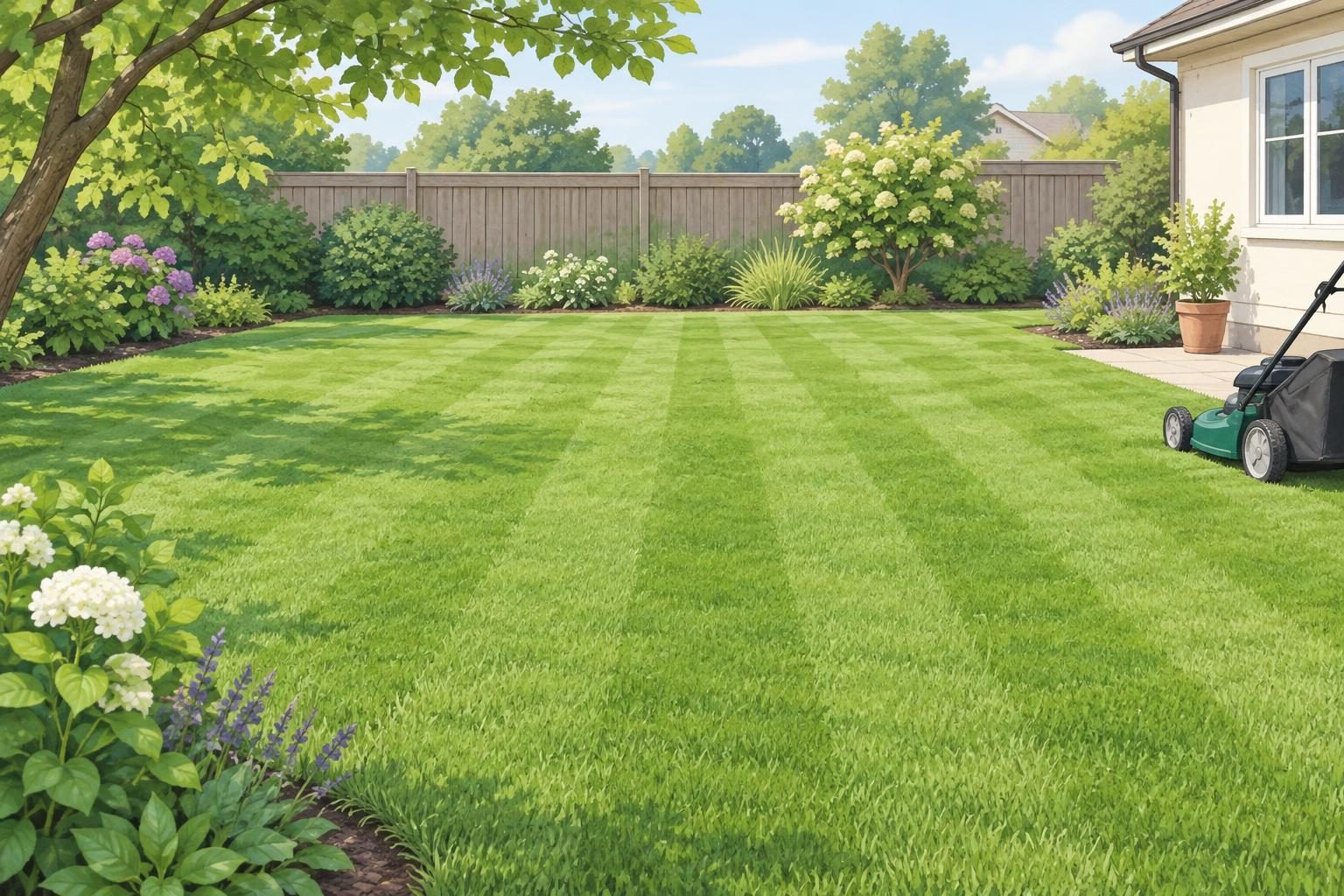
The best height for a typical cool-season grass lawn
For a typical home lawn in a cool climate, the University of Minnesota Extension recommends keeping turf at 3 inches [1]. That guidance is written for northern lawns built mainly on Kentucky bluegrass [1] and similar cool-season species. These grasses grow actively in spring and fall and slow down in summer heat.
A 3-inch target is a practical middle ground. It leaves enough leaf for the plant to feed itself and shade the soil, yet it is short enough to look neat and keep the mower running smoothly. If your lawn is mainly Kentucky bluegrass [1] or a similar cool-season mix, this is a sound place to start.
The height setting is only part of the guidance. The rest is how much you take off at once and how you shift the setting with the seasons. The table below brings the four pieces together, and the sections that follow explain each one.
| Situation | Guideline | Why it helps |
|---|---|---|
| Standard home lawn | Keep it at 3 inches [1] | Leaves enough leaf for steady growth |
| Timing the next cut | Mow before the grass reaches 4.5 inches tall [1] | Keeps each cut within the one-third limit |
| Every mowing | Remove no more than 1/3 of the leaf tissue [1] | Limits the energy the plant loses at once |
| Mid-summer heat | Raise the height by an inch during mid-summer [1] | Helps the lawn handle heat and drying winds |
Know your grass type before setting the deck
The 3-inch figure comes from guidance for cool-season lawns, so do not apply it to every yard without knowing what you grow. Warm-season grasses grow differently. Some spread by low runners that hug the soil, others form coarse, upright blades, and their preferred cutting heights differ from those of Kentucky bluegrass [1]. If you set a southern lawn to a cool-season height, or the reverse, it can end up thin, patchy or scalped.
Knowing which grass you have is therefore the first step. Our overview of different types of grass explains the main cool- and warm-season groups and the regions where each is usually grown. If you already know your species, its own care guide covers a suitable height range:
- How to care for a Bermuda grass lawn
- How to care for a zoysia grass lawn
- How to care for a St. Augustine grass lawn
- How to care for a centipede grass lawn
- How to care for a Bahia grass lawn
If you are not sure what you are growing, ask your local extension service or a turf professional to identify it. That is worth doing before you change your mowing routine, and especially before you reseed, because the wrong species for the site will struggle at any height.
Many lawns are mixtures, especially older ones or lawns that have been overseeded with different products over the years. A mixed lawn can include grasses that prefer different heights, and an expert who sees the lawn in person can tell you which species dominate and what compromise height suits them.
If shaded areas look thin no matter how you mow, the cause may be the grass choice rather than the mower. Our guide on how to choose grass seed for shade covers species that cope with lower light.
The principles in the rest of this guide apply to every species: keep a consistent target, avoid removing too much at once, and keep the blade sharp.
How to tell when it is time to mow
Mow by height, not by the calendar. Grass grows at very different speeds through the year. A fixed weekly routine can mean mowing too often in a dry spell and not nearly often enough during a wet spring flush.
The University of Minnesota Extension gives a clear trigger: to maintain a 3-inch lawn, mow before the grass reaches 4.5 inches tall [1]. That timing ties directly to its second rule, which is to remove no more than 1/3 of the leaf tissue when you mow [1]. If you mow on that schedule, each cut stays within the one-third limit.
The two numbers fit together. Three inches is two-thirds of a lawn that is 4.5 inches tall [1], so cutting at that point takes off exactly the one-third the rule allows. Wait longer and the same cut back to 3 inches removes more than a third, even though the mower setting has not changed.
The one-third limit leaves most of the green leaf in place, so the plant keeps feeding itself while it regrows. Cut harder and the lawn often looks pale or straw-colored afterward, because what remains is lower, older stem and leaf tissue with less green in it.
Tip: In spring and fall, when cool-season lawns grow quickly, check the lawn mid-week as well as on your usual mowing day. If it is already closing in on 4.5 inches tall [1], mow early rather than waiting for the weekend.
If the lawn has already got away from you after a holiday or a run of rainy days, do not cut it straight back to its usual height. Bring it down in stages instead. Take no more than one-third of the leaf each time [1] and give the grass time to recover between passes. It takes longer, but it avoids the scalped, yellowed look that follows one heavy cut.
New lawns need extra care. Seedlings have shallow roots, and mowing too early or too low can tear them out of the soil. Keep the seedbed evenly moist as described in how often to water new grass seed. Once the young grass is tall enough to mow, follow the same one-third rule.
Adjusting mowing height through the seasons
One height for the whole year is a reasonable starting point, but the lawn's needs change with the weather. Cool-season grass is under heavy strain in mid-summer, when long hot days and drying winds pull water out of the leaves faster than the roots can replace it.
The extension advice is to increase the mowing height by an inch during mid-summer to improve the lawn's ability to tolerate stress caused by heat and drying winds [1]. The extra leaf shades the crown of the plant and the soil around it, and the deeper canopy holds a little more moisture near the ground. Raise the deck when hot weather sets in, before the lawn has started to brown.
When temperatures ease and growth picks up again in late summer or early fall, return the deck to the usual 3 inches [1]. Lower it gradually rather than all at once, so that no single cut breaks the one-third rule [1].
Other seasonal points to keep in mind:
- In early spring, start mowing once the grass is actively growing and needs a cut, rather than on a set date.
- In a summer drought, cool-season lawns may go dormant and turn tan. Dormant grass grows very little, so mow only when it actually needs it and keep heavy traffic off the lawn where you can.
- Late in the season, keep mowing at your normal height for as long as the grass keeps growing, so it does not go into winter long and matted.
These adjustments matter more than finding an exact number. A lawn that is kept a little taller in the heat and cut regularly at a sensible height will usually look better by late summer than one held short all year.
Keep the mower blade sharp
A good cut depends on the blade as much as on the height setting. Dull blades leave jagged edges and plants are more susceptible to diseases [1]. A sharp blade slices each leaf cleanly. A dull one tears it, leaving ragged, shredded tips that dry out and discolor. From a distance, the whole lawn takes on a dull, whitish cast.
The problem compounds over time. Every mowing with a dull blade adds a fresh set of torn tips across the whole lawn, and each damaged leaf is under more strain than a cleanly cut one. In hot or humid weather, when turf is already stressed, that extra damage can tip a lawn from looking tired to showing patches of disease.
Warning: Mowing with a dull or damaged blade for a full season can open the way for leaf diseases across the lawn. Treating disease or reseeding thinned patches costs far more time and money than having the blade sharpened or replaced, so do not put it off. Before you handle the blade, disconnect the spark plug wire or remove the battery, and follow the mower maker's instructions.
Look at the grass tips after you mow. Clean, square cuts mean the blade is doing its job. Jagged, frayed edges are the sign of dullness described above [1], and the blade needs sharpening or replacing.
If you are not confident sharpening and balancing a blade yourself, a mower service shop or dealer can do it. They can also explain how your machine's height settings relate to the finished height of the grass, which differs between makes and models.
Common mowing height mistakes
These mistakes come up again and again, and most are easy to fix once you know about them.
- Cutting short to mow less often. Scalping the lawn so you can skip a week removes far more than one-third of the leaf [1] and leaves the turf weak and open to weeds.
- Letting it grow shaggy, then cutting it all at once. This breaks the same rule from the other direction. Mowing before the grass reaches 4.5 inches tall [1] keeps a 3-inch lawn on track.
- Lowering the deck in summer for a tidier look. In hot weather the lawn needs more leaf, not less, which is why the guidance is to raise the cut by an inch during mid-summer [1].
- Using one height for every grass type. A cool-season setting does not suit every warm-season lawn, so find out which species you have first.
- Changing height in big jumps. Moving the deck a long way down in one go can mean a single cut takes off more than one-third of the leaf [1], so shift it over several mowings.
- Ignoring the blade. A correct height setting still gives a poor result if the blade tears the grass instead of cutting it [1].
- Blaming mowing for every problem. Yellow patches, thin areas and weeds can also come from watering, soil or fertilizer issues, so look at the whole picture before you change the mowing height.
When to get expert help, and a faster way to check your grass
Getting the mowing height right fixes a lot, but not everything. If a lawn stays thin, patchy or discolored after a good stretch at a steady height with a sharp blade, the cause probably lies elsewhere. Disease, insects, compacted soil, poor drainage or a grass type that does not suit the site are common culprits. In that case, contact your local extension service or a turf professional who can inspect the lawn in person.
It also makes sense to ask for help if you cannot tell what grass you are growing, if your lawn mixes cool- and warm-season species, if bumpy ground leaves bare, scalped spots after mowing, or if you plan to reseed and want a species that suits your sun, shade and climate.
For a quicker first step, Lawn Scan can identify your grass species from a photo and show its ideal mowing height, along with visible health and coverage, so you know which height guidance applies before you adjust the deck.
Common questions
- Is it better to cut grass short so you mow less often?
- No. Cutting a lawn very short removes much of the leaf the plant uses to feed itself, which weakens the roots, dries out the soil faster and gives weeds room to move in. You save one mowing, but the lawn ends up thinner and patchier.
- Should I mow higher or lower in summer?
- Mow higher. Cool-season lawns are under heavy strain in hot, windy weather, and leaving more leaf in place helps them cope with heat and dry spells. When cooler weather returns, lower the deck back to the usual setting gradually.
- What should I do if my lawn has grown far too tall?
- Bring it down over several mowings rather than in one pass. Take off only a modest portion of the leaf each time and let the grass recover between cuts, then go back to your normal schedule once it is at the target height.
- Does the same mowing height work for every type of grass?
- No. The usual guidance for northern lawns is written for cool-season species, while warm-season grasses such as Bermuda, zoysia and St. Augustine have their own preferred ranges. Find out which grass you have, asking a local expert if you are unsure, and follow the advice for that species.
- How can I tell if my mower blade is dull?
- Look closely at the grass tips after mowing. Clean, even cuts mean the blade is sharp, while jagged or frayed edges mean it needs sharpening or replacing.
Sources
Keep reading
 AI illustration